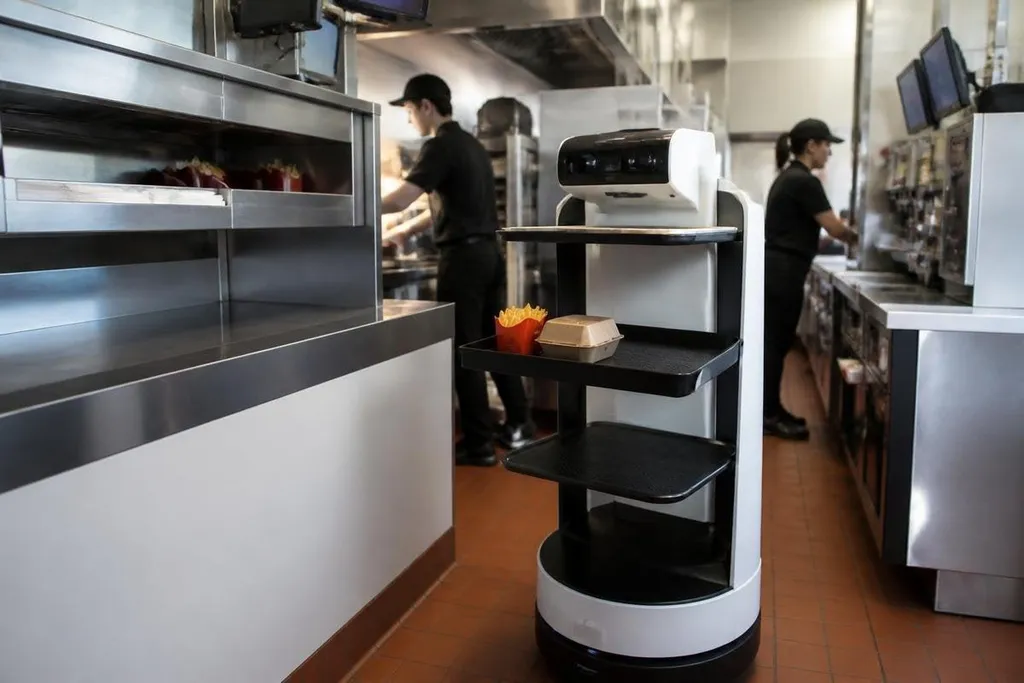
A restaurant robot doesn't need to cook an entire menu to change a fast-food kitchen. Moving trays, filling drinks, or placing food in a pickup bay could remove small delays from every order.
For an operator, the useful question is narrower: which task can a robot repeat safely, for long periods, without slowing the people around it?
- Repetitive tasks are the clearest starting point.
- Staff would still handle cooking checks, cleaning, and customer problems.
- A robot must fit the kitchen before it earns a place in it.
Where robots could work first
The best fit is a task with a fixed location, a clear start and end, and little need for judgment. A robot arm could move a fryer basket, place a wrapped meal in a bag, or load a drink into an order tray.
For ingredient runs, a mobile robot could carry supplies from a cold store to a prep bench if the route stays clear.
Those jobs matter because they happen beside the main work. A worker who stops assembling an order to fetch a tray loses time twice: once during the walk, and again while returning to the station. A robot could handle that movement while the worker stays at the bench.
Food handling adds limits. Grease, steam, spills, heat, and tight spaces can affect cameras, grippers, wheels, and cables. A robot that works on a clean test table may need different parts, covers, or cleaning steps inside a kitchen.
What changes for staff
The first effect may be a change in job tasks rather than an empty kitchen. People would still need to check food, respond to unusual orders, refill supplies, clean surfaces, and deal with customers. Those jobs need judgment that a fixed robot arm won't have.
Training would change too. A shift lead might need to clear a jam, restart a system, or move a robot out of a work area. That adds a new duty, so the robot must save more time than it takes to supervise.
This is where many plans can lose their value. If staff must watch every move, reload the robot after each order, and stop production for minor faults, the machine has moved work around rather than removed it.
A fast-food operator needs proof that a robot can finish a task without staff taking over. Restaurant robotics reporting from Robot24.com names the machine, test site, and date, which matters when the kitchen layout has to change around it.
The kitchen has to change around the robot
A fast-food kitchen is built for people who can reach across a counter, carry several items, and adjust their grip. A robot needs known positions, steady lighting, room for movement, and objects it can hold in the same way each time.
That may mean using trays with fixed slots, placing ingredients in marked bins, or changing the height of a work surface. Packaging could matter as much as the robot arm. A soft bag that bends in a human hand may give a gripper trouble.
Software also has to connect the robot to the order system. The system needs to know which item is ready, where it should go, and what happens when an ingredient runs out. A human must have a clear stop control, with space to reach it during a busy shift.
What remains unproven
A demo can show that a robot picks up one item. It does not show how the same system handles a wet counter, a missing lid, a changed order, or a crowded handoff area. Those cases decide if the machine helps during a real shift.
Cost matters beyond the purchase price. Operators would need to account for installation, software, cleaning, repairs, staff training, and lost service during setup. A low-priced arm may still be a poor fit if the kitchen needs costly changes around it.
I'd wait for proof from a live restaurant before treating a robot as a labor-saving purchase. The proof should include service speed, fault recovery, cleaning time, and the hours of staff supervision required.
A practical buying check
Before a restaurant starts a pilot, the operator should check:
- Name one task: choose a repeated movement with a clear measure, such as trays moved per hour.
- Map the workspace: mark heat, water, walkways, storage, and the human stop point.
- Count handoffs: record how often a person must reload, guide, or correct the robot.
- Test bad inputs: include spills, missing packaging, changed orders, and blocked paths.
- Price the full setup: include installation, training, cleaning, repairs, and downtime.
- Set a stop rule: pause the pilot if safety checks or service speed get worse.
A restaurant robot earns its place when it handles one dull task without adding a new queue beside it. The next useful test is not a polished video; it is a full shift with the clock, fault log, and cleaning record left in view.